

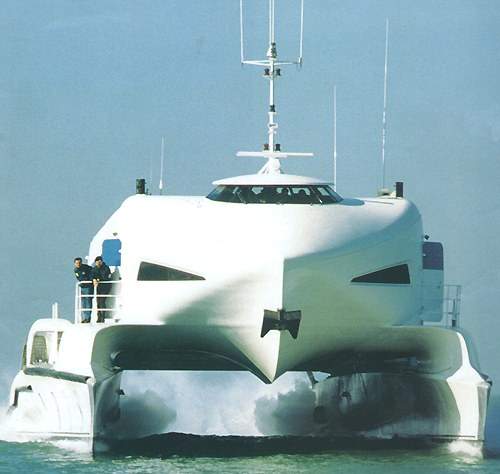
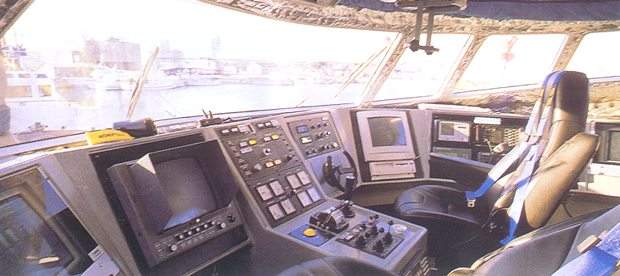
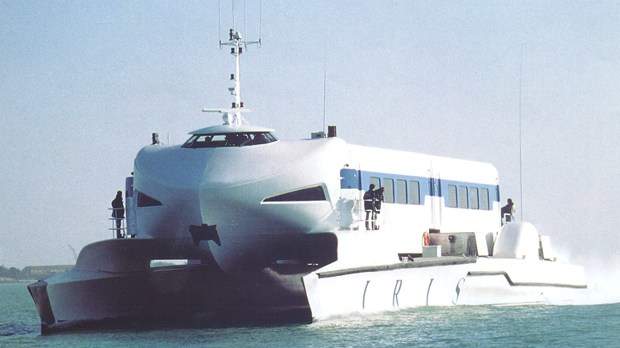
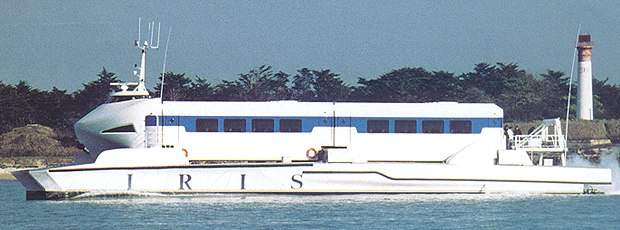
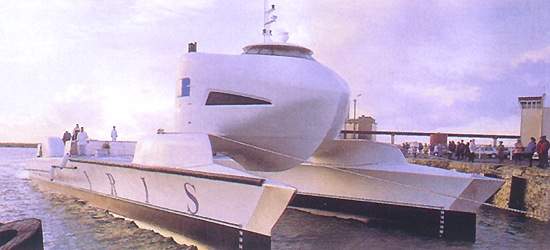
The innovative Iris 6.1 ferry was constructed at Iris Catamarans’ Aigrefeuille shipyard, located near La Rochelle, France. The ferry is owned by the Guadeloupe-based maritime transport organisation TMCA. Iris 6.1 will operate on a network linking Pointe-a-Pitre, on the Caribbean island of Guadeloupe, to the neighbouring islands of Marie-Galante and Les Saintes. The scheduled journey times are in the region of 40 minutes.
Following numerical testing of a series of configurations, the eventual Iris 6.1 design was tank tested at the Marin facilities in Holland. Small scale model testing using self-propelled 1/10th scale models was carried out in 1997, and construction commenced on the full size prototype.
Recommended White Papers
Recommended Buyers Guides

DESIGN
The philosophy underpinning the design concept was the need to achieve three important targets. Most importantly, it had to be able to transport passengers in comfort. In order to impose a mimimal environmental impact on ports, estuaries and banks, it had to generate a low wake at all operational speeds. Lastly, it had to meet these standards without negatively influencing the hull form, which was designed to maximise speed and economy.
Virtually the entire structure of the catamaran is fabricated with Glass Reinforced Plastic (GRP) in a highly novel modular composite sandwich with insulating coatings. The two hulls are joined together by three cross-bridging structures. The midships and aft cross beams are made of rectangular-section aluminium box material and are joined to the hulls via reinforced bulkheads. Due to the inherent complexity of the vessel’s shape, however, the fore-beam is integrally moulded with the composite forward cabin and wheelhouse structure. These beams support a modular payload. While this is normally passenger accommodation, the deck can be outfitted to accommodate freight containers. These modules are secured onto the hulls and cross-beams by means of anti-vibration mountings. This is intended to minimise the transfer of vibration and noise from the machinery rooms, located within each of the catamaran hulls, thus improving the passenger environment. Additionally, the modular construction of the vessel means that it can be easily dismantled for transportation to any location in the world.
The twin hulls of the catamaran ferry have a waterline length of 39.75m. The ferry has an operational deadweight of 51t and it is capable of maintaining a service speed of 29.9 knots in full deadweight condition. The maximum lightship speed is 34.2 knots. The hulls, wheelhouse, passenger modules and aft deck are produced using vacuum bagging techniques with single-skin laminate used in shock sensitive areas. Both the wheelhouse and passenger modules are the work of Olivier Flahault Design.
Based on this design, Iris has developed an Iris 6.2 version in which the deadweight has been increased to 72t. By the addition of a second deck and increasing engine size, the ferry can carry 398 passengers. Power is provided by a pair of MTU 16V 4000 M70 diesels, rated at 2,320kW at 2,100rpm, to give anticipated speeds of 38 knots maximum and over 30.5 knots at full load. A fleet of Iris 6.2 catamarans are to ferry visitors around Lakes Neucatel, Morat and Bienne.
FACILITIES
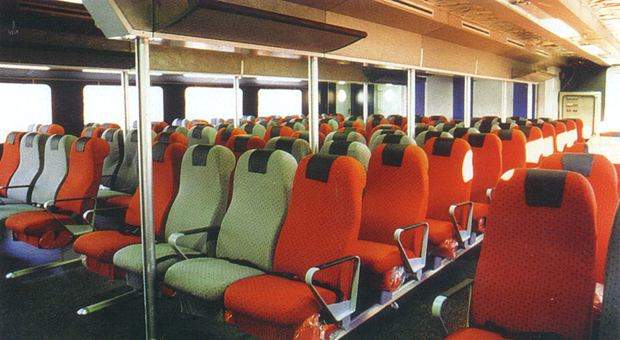
The passengers are accommodated inside two linked modules, providing a total seating capacity for of 240 people. The interior fitting, as well as the supply of seating, has been provided by the UK-based company, Merok Marine International. It is set in a 2-4-4-2 configuration.
PROPULSION
The Iris is powered by two MTU 12V 4000 M70 diesels each rated at 1,740kW. Each main engine drives a Lips LJ76 DL waterjet propulsion unit.
The tank capacity is 7t, giving an endurance of 10 hours.
