

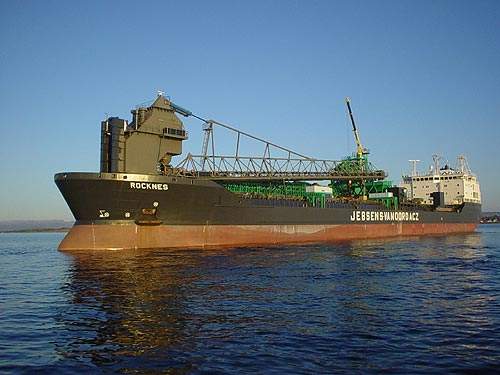
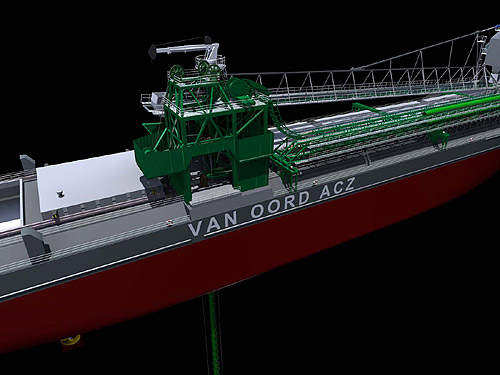
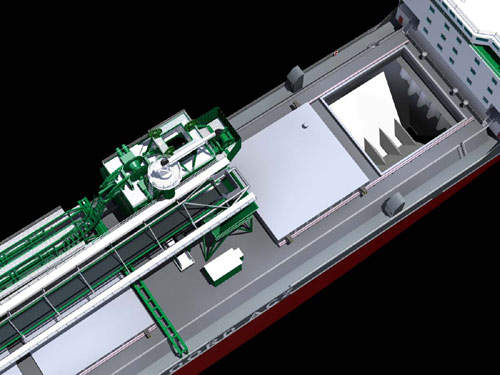
Owned by offshore contractor Van Oord ACZ, the Rocknes fallpipe vessel was the largest of its kind in the world. The hull was originally fabricated by J.J. Sietas in Hamburg, however, recognising the applicability of the basic design to its own requirements, Van Oord immediately took the bulk carrier to the Keppel Verolme yard to have fallpipe facilities installed.
The Rocknes capsized on 19 January 2004 whilst carrying a cargo of rocks off the west coast of Norway. Only 12 of its 30 crew survived the incident.
Recommended Buyers Guides

The Rocknes was designed to carry out a number of offshore rockdumping operations. These included the stabilisation, protection and covering of cables, pipes and flowlines, freespan correction, upheaval buckling prevention and filling up holes around platforms, structures and rigs. Other operations include seabed preparation prior to pipe laying, construction of underwater berms, thermal insulation of oil lines, protection against anchors and fishing operations and ballasting of platforms, structures and loading buoys.
The Rocknes had a length of 166.3m, a 24.5m beam and a 10.5m draught. It registered a deadweight of 28,115t and a loading capacity of 25,500t. It had accommodation for 50 persons.
FLEXIBLE FALLPIPE
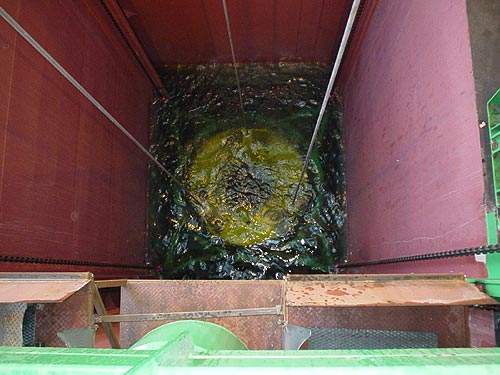
The vessel had 40% more loading capacity than the second-largest fallpipe vessel in the world, the Seahorse. The aggregate material was discharged through the flexible fallpipe, a tubular structure the length of which could be adjusted according to the working depth. The material could be accurately deposited just a few metres above the seabed. The fallpipe measured 1.1m in diameter and provided a dumping capacity of up to 2,000t/h.
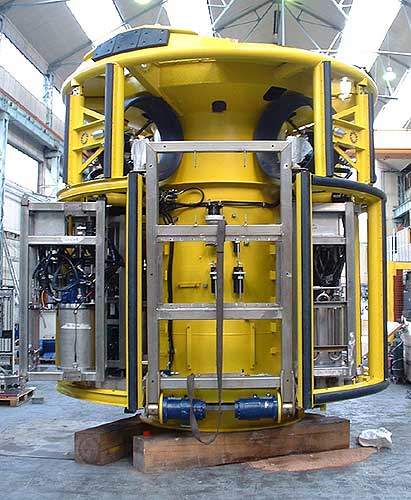
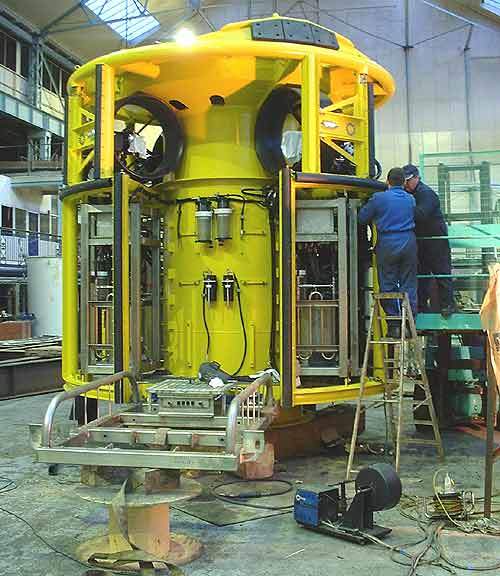
A powerful cylindrical shaped ROV (remotely operated vehicle) was installed at the lower end of the fallpipe to funnel the sand and rock material. Called the Medusa, it was a cylindrical ROV with a diameter of 3.8m and height of 3.7m. It weighed 15t in air and 12.8t in water. It was based on an S355 (ST52) carbon steel space frame with a vertical tunnel through the centre to accommodate the Rocknes’ fallpipe. The ROV was equipped with state-of-the-art survey equipment such as subsurface positioning, sonar sensors, cameras and monitoring equipment.
POWER AND MANOEUVRING
The main power supply was from a four-stroke engine with an output of 7,300kW. This drove a Lips controllable pitch propeller of 4,900mm diameter with a 3C13 hub, giving it a speed of 14.1 knots.
In order to manoeuvre while mooring, the vessel also had a pair of Lips transverse tunnel thrusters. One, located in the bow, was a Lips CT200 unit with an output of 1,200kW while the other, in the stern, was a Lips CT175 unit with a 750kW output. A new Lips CT 200 (1,200kW) and a Lips CT 225 (1,480kW) thruster and motor were installed fore and after of the existing transverse thruster in the bow.
Two additional 360° steerable thrusters were installed for additional movement in all directions during dynamic positioning. The thrusters were retractable to allow unresisted free-sailing speed from one job to another. The retractable azimuthing thrusters were CS225-250/MNR units with 2,100mm controllable pitch propellers in the nozzles.
NAVIGATION AND CONTROLS
Navigation and processing computer systems included a HiPAP, bathymetric systems, mechanical scanning profilers, underwater cameras and lights and Seabat 8125 multibeam scanning sonar. Thales GeoSolutions was awarded a contract to supply four Seabat 8125 units to be used in combination with the latest PDS2000 system used for data acquisition, processing and charting of the Seabat data.
For all activities during pre-installation, installation and post-installation, a very accurate positioning system based on real-time kinematic GPS (Global Positioning System), used in combination with DGPS (Differential Global Positioning System) receivers and subsea transponders, was used to feed the DPS (Dynamic Positioning System) in order to ensure maximum accuracy.
The Rocknes is classified by Germanischer Lloyd under the notation 100, Bulk carrier – A5 – IW – NAV-Ø – ESP MC – AUT – D.P. Class 2
