
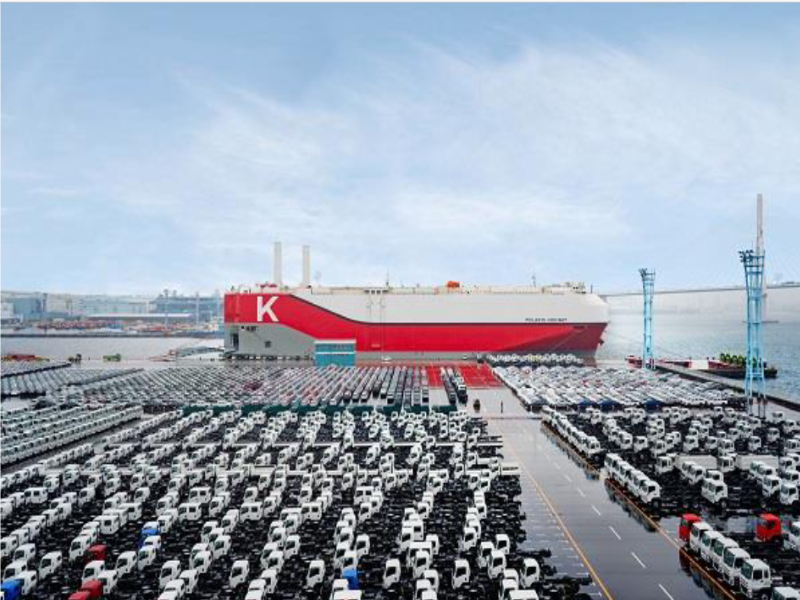
Kawasaki Kisen Kaisha (K LINE) and Daito Corporation have commenced the operation of the Yokohama Daikoku C-4 terminal in Japan, which will use renewable energy.
The pure car and truck carrier (PCTC) Ivory Arrow, operated by K LINE, made the first call at what is said to be the company’s first dedicated finished vehicle terminal in Japan.
Go deeper with GlobalData


Discover B2B Marketing That Performs
Combine business intelligence and editorial excellence to reach engaged professionals across 36 leading media platforms.
With the support of a work facility with a large roof, the terminal is designed to handle various vehicles, such as break-bulk cargoes, in addition to serving as an export and transhipment base for finished vehicles.
K LINE stated: “The terminal will use electric power generated from renewable energy sources with virtually zero CO₂ emissions.”
The terminal will receive 100% wind-generated renewable energy from the blockchain-based electricity traceability service of ‘Minna-Denryoku’, which is managed by UPDATER Corporation.
The terminal has a total yard area of approximately 153,500m², as well as a pier length of 350m and sea depth of 15m. Its parking slots can accommodate around 8,000 units.
Last November, K LINE revised part of its long-term environmental guidelines, “K LINE Environmental Vision 2050”, and set a 2050 target for net-zero greenhouse gas (GHG) emissions.
Recently, K LINE unveiled two conceptual designs for liquefied natural gas (LNG)-driven and battery-powered bulk carriers.
The vessels are being designed in order to cut down emissions while enhancing efficiency in operations.


