
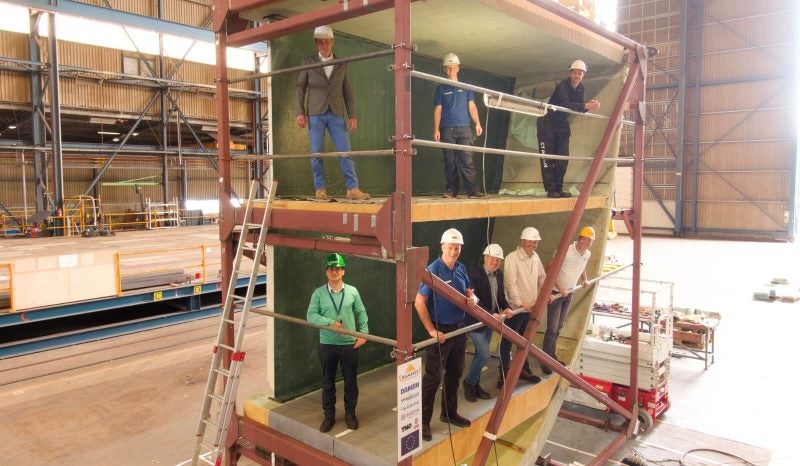
The Realisation and Demonstration of Advanced Material Solutions for Sustainable and Efficient Ships (RAMSSES) project has unveiled the hull section of the full-scale composite ship.
It marks the completion of a significant milestone in the construction. The hull was under development for the past three years.
Go deeper with GlobalData


Discover B2B Marketing That Performs
Combine business intelligence and editorial excellence to reach engaged professionals across 36 leading media platforms.
The hull was unveiled by the project partners at the Damen Schelde Naval Shipbuilding (DSNS) location in the Netherlands.
The Custom Made Hull for Offshore Vessel is one of the thirteen demonstrators that are a part of the RAMSSES project.
The project will now carry out a series of tests, which will showcase the feasibility of large composite ships as a sustainable shipping solution.
Such vessels will weigh 40% less than the steel equivalent vessels and also offer a considerable decrease in fuel consumption and emissions.

US Tariffs are shifting - will you react or anticipate?
Don’t let policy changes catch you off guard. Stay proactive with real-time data and expert analysis.
By GlobalDataHowever, due to the absence of approved guidelines, the regulations that cover the composite shipbuilding only include vessels up to 500t, which is approximately 25m long.
RAMSSES project aims to scale up the composite technology and capacity to develop composite vessels, which are approximately 85m long and comply with Safety of Life at Sea (SOLAS) and class regulations.
DSNS led the work section of the project and Damen Shipyards Gorinchem (DSGo) was responsible for the baseline design development.
The engineering was carried out by Airborne UK and InfraCore Company, while Evonik developed the resin for the infusion of the composites.
After the assembly, TNO will carry out the full-scale tests for design, quality management and structural performance validation.
DSNS Research and Technology Support senior engineer Marcel Elenbaas said: “The work we are doing here is important for the future of shipping. Sustainability is a major focus in the industry right now and shipbuilding is no exception.
“The use of composites for larger ships has significant consequences for the entire design of the ship. If it is lighter, a vessel uses less fuel and produces lower emissions. The vessel also requires smaller engines, which means more space for additional systems, making for a more versatile platform.
“And of course, composites require considerably less maintenance than a steel vessel. With RAMSES we have the opportunity to demonstrate the effectiveness and viability of large-scale composite shipbuilding.”



