

One of the latest innovations in the heavy cargo ship market to address increasing fuel prices has been a return to wind power.
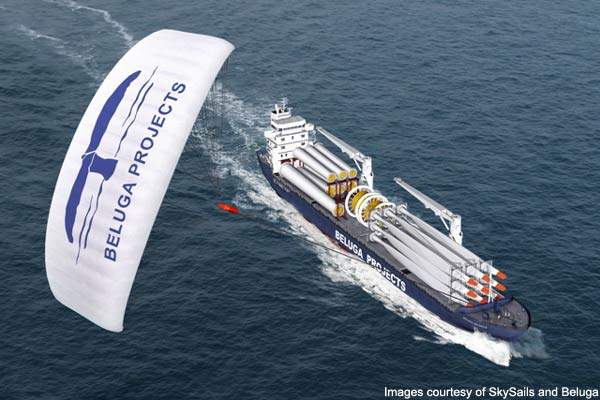
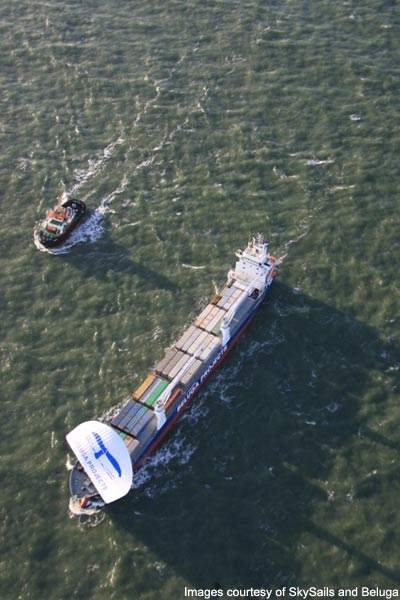
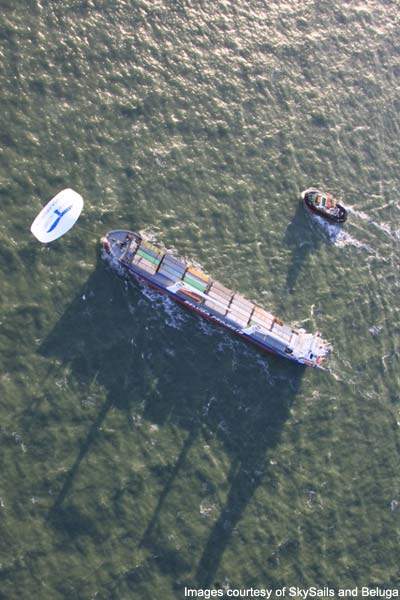
The MS Beluga SkySails is a heavy lift carrier that uses a towing kite system as part of its propulsion systems.
Recommended Buyers Guides

The ship was launched in December 2007, and following early sea trials in the North Sea in January 2008, the vessel embarked on its maiden voyage from Bremerhaven, Columbuskaje to Guanta, Venezuela.
On route, the efficiency of the SkySails system was tested for up to eight hours a day were applicable in winds of up to force five. The system was hailed as a success, with calculated savings of up to 2.5t of fuel/$1,000 a day. With larger sails of up to 600m², fuel savings of between 10% and 35% are possible. The Beluga SkySails will have a new 320m² sail installed as a continuation of its pilot testing.
CONSTRUCTION
The ship was constructed between 2006 and 2007 in the Volharding Shipyards in Harlinghen in the Netherlands and is owned by the Beluga Group (Beluga Fleet Management GmbH).
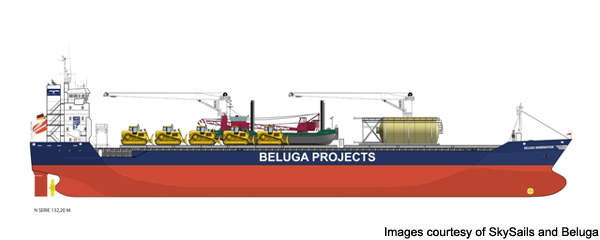
The ship is 132m long with a deadweight 9,821t, a beam of 15.8m, a draft of 7.73m, an air draft of 37.50m to keel (29.77m +7.73m draft) and a cruising operational speed of 15.5kt.
The ship has two holds and a cargo capacity of 474 TEU (alternative 228 FEU and 18 TEU) with 20 reefer plugs. The hold form is box-shaped and double-skinned with both being fully open hatch.
The MAK 8M32 diesel engine from Caterpillar has an output of 3,840kW with a volcano clutch, a transmission and a high-screw four-blade variable pitch propeller (Wärtsilä GMCP 800). There is one Wärtsilä electric bowthruster of 500kVA and the rudder is a free-hanging balance type from Rolls-Royce.
There is a shaft generator (Stamford HCM 534 F2) of 813kVA, two diesel generators (Scania DI 12-62M) of 335kW, and one diesel emergency generator of 85kW (Stamford UCM 224 G SISU 420 DSRG). There are tanks for 3,540m³ of ballast water, 73.1m³ of fresh water and 621.7m³ of heavy fuel oil.
SKYSAIL
The SkySails system has been developed by SkySails GmbH and Co KG. The Beluga SkySails has been equipped with a 160m² sail similar to a paragliding sail. The area of the kite can be increased to 320m² if required for even more pulling power.
The computer-controlled kite is attached to the ship by a rope system and is deployed from an automatic pod. The system can control the kite at heights between 100m and 500m to maximise the benefit of the wind.
With the price of oil so high, an average 87m cargo ship could save nearly €300,000 a year. The system can be potentially retrofitted to any ship and SkySails estimates the potential market to be 60,000 ships over the period up to 2013.
The company expects to install the system on 400 ships. The global reduction of carbon dioxide from shipping could come to 150 million tons per year.
