

For the shipping industry, cylinder liner wear in two-stroke engines provides a major challenge as it directly impacts operational continuity and uptime.
The engines used for propulsion in deep-sea vessels operate with variable loads, exposure to high pressure, corrosion from salinity and humidity, long piston strokes, fluctuating speeds – and varying fuel quality which expose engine cylinders to rapid wear.
But if left unchecked, excessive cylinder liner wear can result in several scenarios such as unexpected engine failures or unplanned shutdowns, increased fuel and lubricant consumption, and downtime – and the impact on OPEX and CAPEX can be significant.
The situation is compounded by latent wear that remains hidden until severe damage or engine failure occurs. With traditional maintenance regimes tending to be based on planned maintenance based on OEM stipulated guidance or visual inspections, anticipating problems can happen too late, leading to higher costs, compliance issues, and operational risks.
However, there are companies that provide established technologies and maintenance support that help mitigate these risks. Mobil is one, offering a supportive decision framework with a network of field engineers and consultants – backed up with cylinder monitoring – that ensures expert‑guided maintenance decisions over the long term and is aligned to OEM recommendations.
Cylinder liner degradation
Cylinder liner wear can be caused by several factors such as corrosion from high sulphur fuels, cat fines, combustion by-products, and acid formation, combined with the harsh marine environment.
Added to this, damage from abrasion through particulate ingress or metallic debris can occur due to parts deterioration or poor filtration. Tribological factors also play their part because of the inherent engine operation, with components in constant relative motion, plus insufficient lubrication or lubricant condition all increasing the risk of damage[i].
Advanced onboard monitoring systems now offer operators the ability to detect wear and action pre-emptive preventative maintenance to improve a fleet’s performance and keep costs down.
Predictive technologies
The emergence of predictive technologies to counter cylinder issues has helped support better monitoring of a ship’s engine health, with real-time monitoring, sensors that can measure vibration, temperature, and wear particles, providing early detection of performance deviations. In conjunction with routine sampling and analysis of engine lubricants for metal concentrations, viscosity, and contamination further insights are obtained through the use of trend analysis to prevent severe wear.
The benefits of predictive maintenance and what early detection offers to fleet operators is considerable – reduced unplanned stoppages and avoidance of catastrophic failures, operational savings from optimised engine performance, and longer intervals between major overhauls.
Mobil Cylinder Condition Monitoring
Mobil Cylinder Condition Monitoring (CCM) has emerged as a comprehensive solution for tackling engine wear detection, offering a simplified, cost-benefit oriented solution, augmented by Mobil’s technical support and guidance network available to users.
CCM is a data‑driven maintenance solution, combining advanced monitoring technology with Mobil’s global engineering expertise, to help operators/marine professionals move from reactive intervention to confident, predictive decision‑making. It employs a combination of advanced sensors, routine oil analysis, and real-time data analytics to constantly track key engine parameters and wear indicators. It enables detection of early signs of abnormal wear – long before traditional inspections would reveal a problem. This solution is designed to aid operators shift from reactive intervention to proactive and predictive decision making.
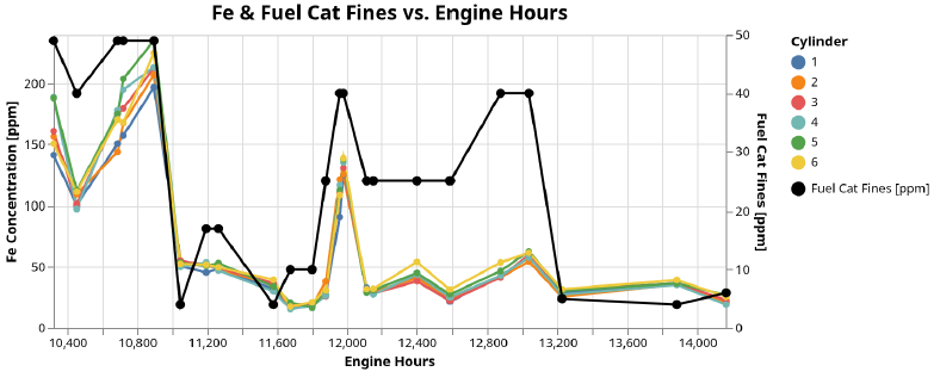
The graph clearly shows how quickly cylinder condition can change, even within 200 operating hours intervals. This underlines the value of regular monitoring through Mobil CCM, which provides a more frequent and detailed view of engine wear trends and lubricant performance.
Changes in fuel batches can also have a noticeable impact on cylinder condition. By tracking iron and Chromium levels and fresh fuel cat fines consistently, operators can better understand the effects of operational changes, assess the current condition of their engines, and take proactive measures to optimize performance and minimize wear.
Furthermore, CCM’s predictive, data-driven maintenance actions reduce unplanned stoppages, consequently minimising costly repairs, and extends engine overhaul intervals, increasing the lifespan of an engine’s components whilst operationally, it optimises engine performance and oil consumption.
One vessel operator used CCM to gain real-time insight into the engine condition of a vessel, whilst optimising the feed to protect the engine from premature wear – the crew was able to reduce the feed rate considerably and identify issues such as abnormal wear. This resulted in a 19% reduction in cylinder oil consumption and reduced liner wear by 53%. Following these results, the service was expanded across much of the fleet[ii].
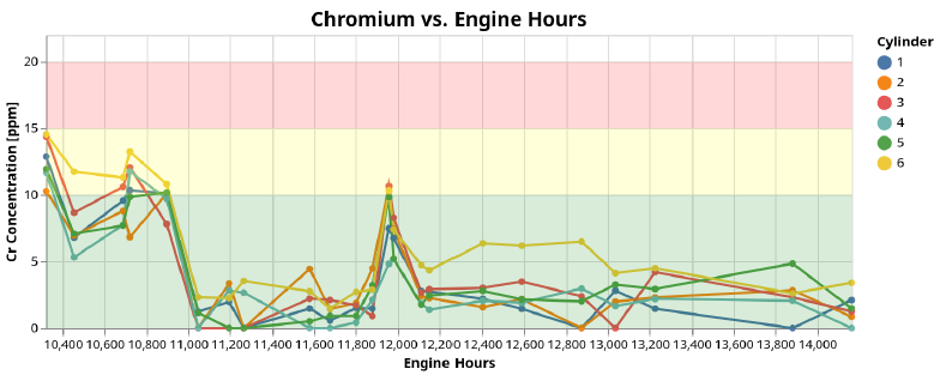
The above graph illustrates chromium trends versus engine hours. Rising chromium levels can indicate increasing piston ring wear, which may eventually also affect cylinder liner health if not addressed. Regular monitoring enables operators to detect these changes early and take appropriate corrective actions before more significant damage occurs. This insight supports a proactive maintenance strategy, helping to improve equipment reliability, reduce operating costs, and maintain optimal engine performance.
For fleet operators, this translates into quantifiable ROI from CCM implementation through a combination of direct cost savings, efficiency gains, and risk reduction, measured against the investment in hardware, software, and process integration.
CCM cuts maintenance costs by reducing breakdowns which – depending on vessel type and circumstances – can run into hundreds of thousands of dollars per incident (repairs, emergency dry-docking, lost revenue) and avoids expensive liner and piston replacements or last-minute procurement at higher prices. It helps extend maintenance overhaul cycles through data-driven condition assessments, reducing frequency and labour costs whilst minimising routine inspection due to automated monitoring and targeted interventions.
In terms of lubrication, CCM enables a targeted approach, lowering oil costs (a major OPEX outlay) and, by monitoring cylinder health, maintains engine efficiency. This minimises downtime and schedule disruption – preserving charter revenue and customer confidence.
In another case, a fleet operator needed to manage fuel switching safely and effectively. The operator was looking to implement a remote monitoring system, spot developing issues before they became critical, but also optimise cylinder oil consumption. Working with ExxonMobil field engineers, the team developed a testing regime for the operator. During the process, it identified a specific fuel-related issue on one carrier, which had bunkered 1,500 MT of 0.50% sulphur fuel oil, but analysis indicated unexpected compounds. To manage the problem, the crew increased the frequency of CCM analysis to observe engine operations more closely. Resulting data showed that conditions within the engine remained within acceptable levels, enabling the vessel to burn its fuel, avoiding the significant financial hit of debunkering and associated vessel downtime[iii].
With CCM, shipping operators can shift from reactive, costly maintenance to a proactive, optimised management system – safeguarding both operational reliability and profitability.
Greater transparency lowering costs
Advance onboard monitoring systems help to enable fleet operators to transparently monitor vessels or whole fleets which ensures alignment with OEM recommendations, supporting better operational management and avoiding costly downtime and delays. Moreover, engineers can now collaborate with operators to develop strategies that optimise oil and equipment health, reduce wear, and maximise savings in real time.
By shifting from more traditionally reactive to pre-emptive maintenance systems like CCM, operators can troubleshoot issues early, optimise lubrication strategies, and prevent severe wear, helping to lower the total cost of ownership.
Based on the experience of a single customer, actual results may vary depending upon the type of equipment used, its condition, its maintenance, operating conditions and environment and any prior lubricant used.
For more information on how Mobil can help improve your operations and cut costs, download the free paper below.
[i] Tribology in Marine Diesel Engines, Sung-Ho Hong: www.researchgate.net/publication/355676735
[ii] 53% liner wear rate reductions with ExxonMobil: www.exxonmobil.com/en/marine/technicalresource/categories/exxonmobil-voyager-newsletter/berge-bulk-maritime
[iii] Mobil℠ Cylinder Condition Monitoring helps Minerva Gas optimise engine protection across its fleet of LNG carriers: www.exxonmobil.com/en/marine/technicalresource/success-stories/mobil-cylinder-condition-monitoring