
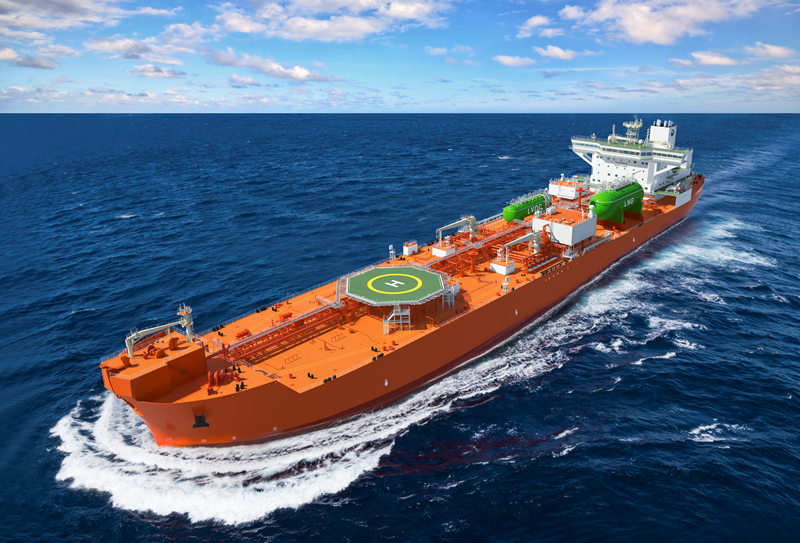
Malaysian shipping company AET has launched its two LNG dual-fuel dynamic positioning shuttle tankers (DPST) in South Korea.
The sister twin-skeg shuttle tankers were revealed at the Samsung Heavy Industries (SHI) Geoje Shipyard in South Korea during a naming ceremony.

Discover B2B Marketing That Performs
Combine business intelligence and editorial excellence to reach engaged professionals across 36 leading media platforms.
Both shuttle tankers Eagle Blane and Eagle Balder have a deadweight tonnage (dwt) of 123,100.
The DPST vessels will emit 40% to 48% less carbon compared to similar vessels built in 2008, positioning them as the most environmentally clean DPST.
The tankers meet the International Maritime Organisation’s (IMO) 2030 target of reducing CO₂ emissions by 40% compared to 2008 and its 2050 goal of reducing CO₂ emissions by half.
Eagle Blane and Eagle Balder are also designed to emit 98% less NOx, 85% less SOx, 93% less black carbon particulates and 98% less particulate matter compared to DPSTs that burn conventional fuel.
OSM Maritime and Eaglestar provided project management services for the vessel construction. The tankers will serve on a long-term charter to Norway’s Equinor.
The vessels use LNG as primary fuel and can also use 100% of the harmful Volatile Organic Compounds (VOC) as supplementary fuel.
By combining LNG dual-fuelling and VOC recovery systems with a dynamic positioning system, the vessels can save approximately 3,000t of fuel annually.
The DPSTs are propelled by two low-pressure dual-fuel two-stroke engines. They feature the latest generation of bow loading system and shaft generator with DC switchboard.
AET president and CEO Rajalingam Subramaniam said: “These vessels are proof that environmental sustainability and commercial viability can coexist and are also a testament to the fact that operational performance does not have to be sacrificed in the pursuit of reducing emissions.”


