
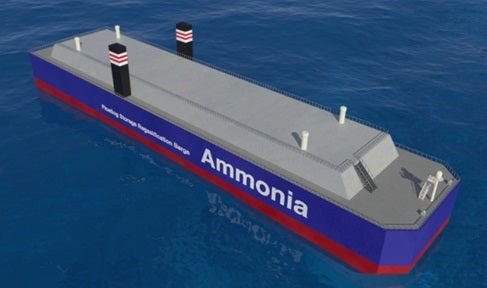
Japanese classification society Nippon Kaiji Kyokai (ClassNK) has granted approval in principle (AiP) to an ammonia floating storage and regasification barge (A-FSRB).
The approval is said to be the first of its kind given to an A-FSRB carrying ammonia as cargo.

Discover B2B Marketing That Performs
Combine business intelligence and editorial excellence to reach engaged professionals across 36 leading media platforms.
Developed by NYK Line in collaboration with Nihon Shipyard (NSY) and IHI, the A-FSRB is an offshore floating unit with the capability to receive and store ammonia.
The barge is designed to accommodate ammonia that has been carried as a liquid by ships. It can then warm and regasify the ammonia before dispatching it to onshore pipelines.
It requires less time and funds for construction than onshore storage tanks and regasification plants, according to the manufacturers of the A-FSRB.
The barge also has the potential to accelerate the use of ammonia as fuel and make it the next-generation fuel that reduces environmental impact.
In order to give its approval, ClassNK undertook a review of the design of the A-FSRB in accordance with its Part PS of Rules for the Survey and Construction of Steel Ships.
The classification society also took into account its Guidelines for Floating Offshore Facilities for Liquefied Natural Gas (LNG) and Liquefied Petroleum Gas (LPG) Production, Storage, Offloading and Regasification while reviewing the design.
In a statement, ClassNK said: “Currently, there are no international regulations for floating storage and regasification facilities when the cargo is ammonia, and it is expected that the unique requirements of ammonia will have to be reflected in the design.
“Therefore, the companies and ClassNK conducted a comprehensive risk identification of various contingencies and worked to identify technical issues from the initial study stage.
“The risk identification was conducted using the gap analysis method, which identified differences between conventional ships and offshore floating facilities (heavy oil, LNG, etc) and evaluated the impact of such differences.”
Last July, NYK Line and IHI Power Systems (IPS) secured AiP from ClassNK for their ammonia-fuelled tugboat.


