
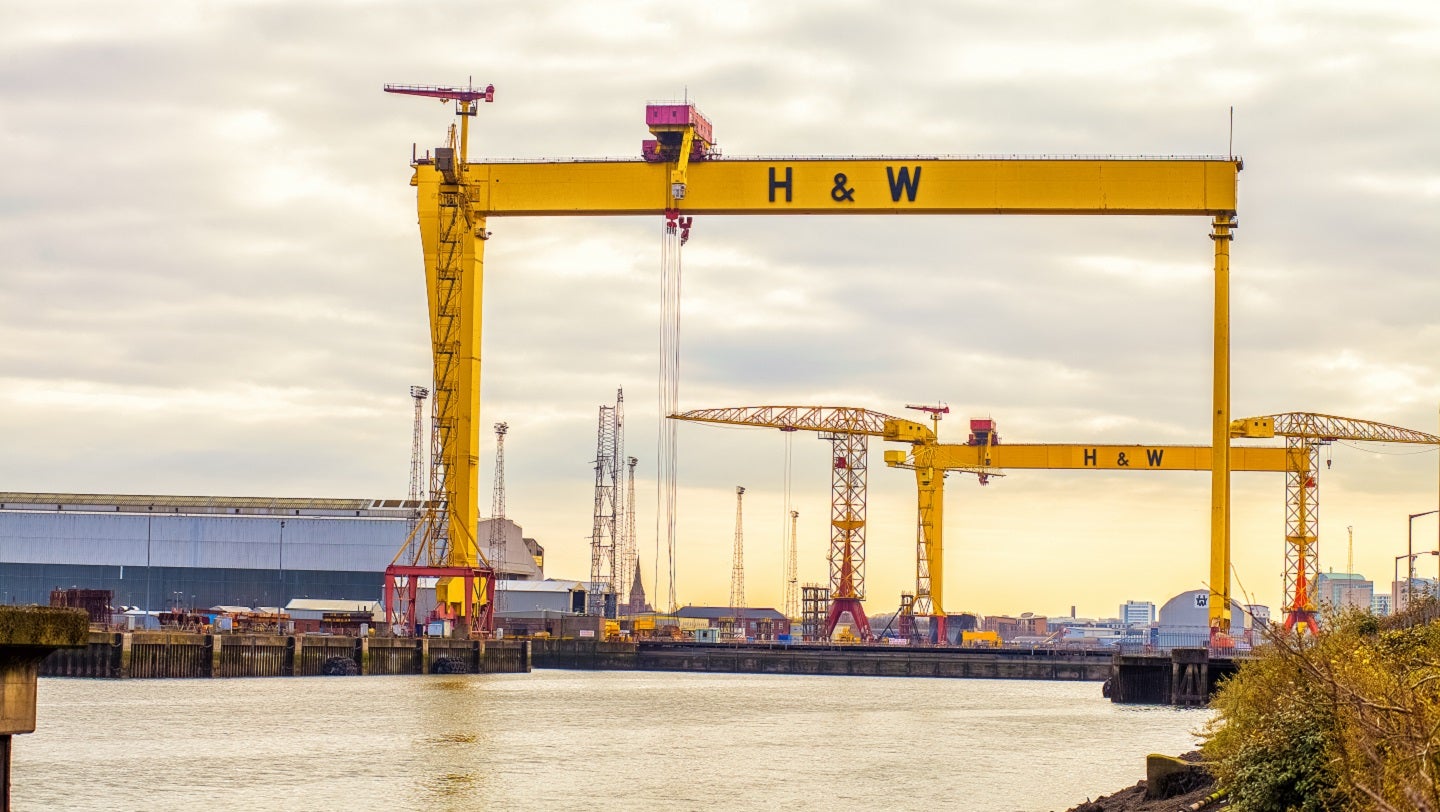
Harland & Wolff shipyard has begun demolition works at its Belfast site as part of preparation and investment plans for the forthcoming block manufacture and assembly of the UK Fleet Solid Support (FSS) class of logistics vessels, destined for the Royal Fleet Auxiliary (RFA).
In January 2023 the UK Ministry of Defence (MoD) awarded a £1.6bn contract to Team Resolute, comprised of UK ship designers BMT, UK shipyard Harland & Wolff (Belfast and Appledore), with Navantia UK, an arm of Spanish shipbuilder Navantia, acting as prime.
Go deeper with GlobalData


Discover B2B Marketing That Performs
Combine business intelligence and editorial excellence to reach engaged professionals across 36 leading media platforms.
The new vessels are being constructed to replace RFA Fort Victoria, a three-decade old sole-ship class that offers capabilities of both stores ship and fleet tanker. Once delivered, the FSS vessels will be deployed to support carrier and amphibious task groups by transporting ammunition, spare parts, food, and other equipment to deployed UK naval assets.
Following the $1.6bn manufacturing contract award, Harland & Wolff, which is a wholly owned subsidiary of Harland & Wolff Group Holdings (previously known as InfraStrata), confirmed it would see £77m invested in necessary technologies for the programme at its Belfast and Appledore sites in Northern Ireland and Devon, England, respectively.
Under the terms of the deal the consortium would deliver three FSS ships to the RFA by 2032, with Harland & Wolff responsible for delivering works worth around £700m to £800m through the life of the programme.
The project will see an extension to the fabrication halls undertaken to enable improved material and sub-structure production flow along the manufacturing process, as well as investment into robotics and autonomous equipment that includes material movement, marking, plate cutting, panel lines, and welding, according to a 27 April release by Harland & Wolff.
In addition, new larger paint buildings will be constructed to facilitate larger and more efficient block painting.
Earlier this year it was disclosed that the creation of an expected 1,200-strong workforce in Belfast had been identified as a “key risk” by the MoD’s senior responsible officer for the FSS programme.
The development of the Belfast site is intended to provide Harland &Wolff with a sustainable roadmap in the defence, commercial, and marine renewables sectors, in an effort to secure the shipyard’s future. In particular, the business will target a significant number of floating offshore wind projects for which fabrication is expected to commence between 2024 and 2030, Harland & Wolff stated.
Timelines of the FSS programme
Full scale fabrication of the FSS blocks is due to begin in 2025 with all three vessels delivered by 2032.
The company’s Appledore site will be responsible for the manufacture of all three bow sections of the vessels, which will be then transported to Belfast for assembly. The Belfast site will see some block builds as well as integration of equipment and military system, while Navantia will perform an as-yet unknown number of block builds at its sites, potentially in Spain.
All three vessels will have all the blocks assembled, consolidated, fully integrated and commissioned before proceeding to sea trials from the Belfast facility.


