
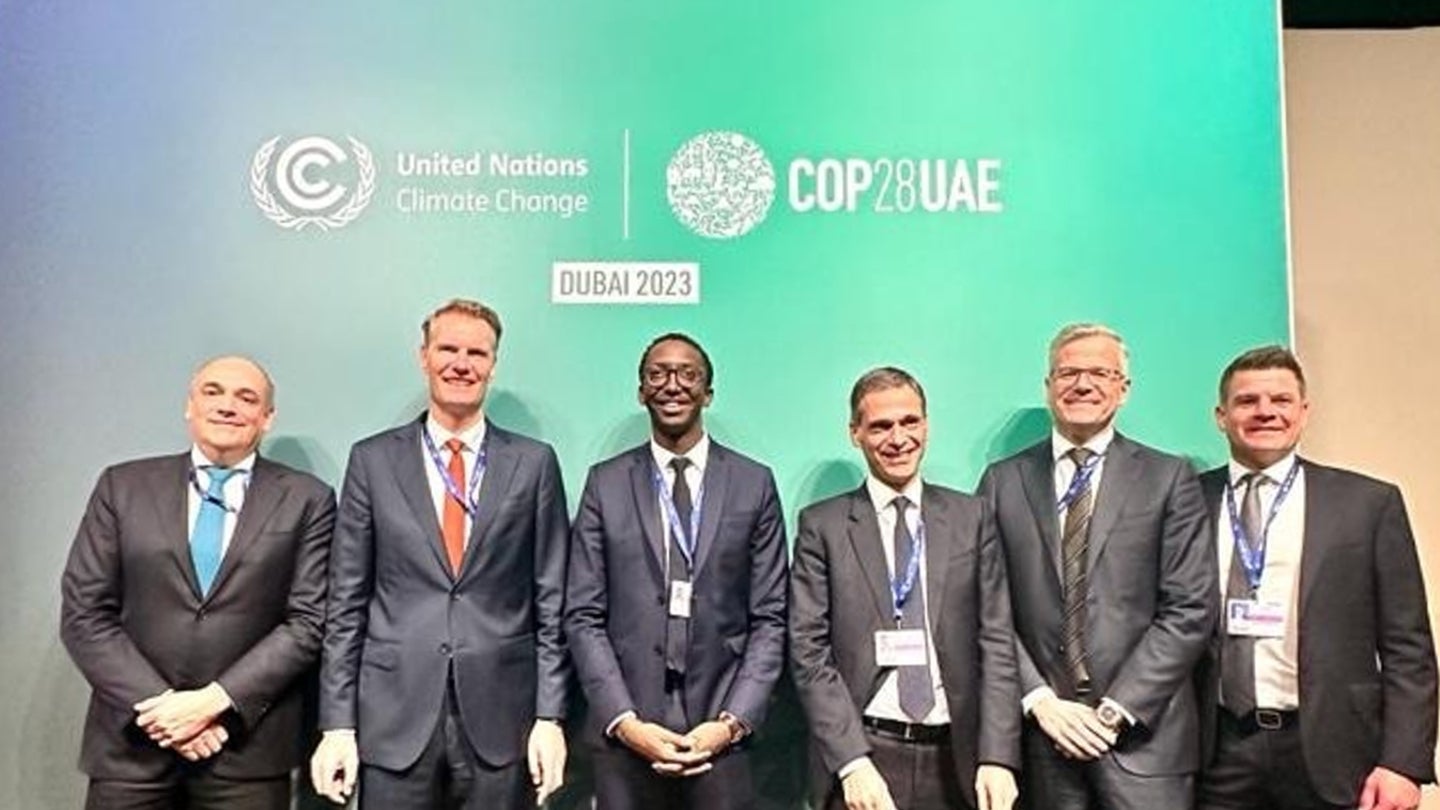
A group of five CEOs representing some of the world’s biggest maritime companies has issued a joint statement calling for more green fuel regulations, including a targeted end to the construction of solely fossil-powered ships during the UN’s COP28 summit.
The group, which includes the leaders of CMA CGM, A.P. Moller – Maersk, Hapag-Lloyd, MSC, and Wallenius Wilhelmsen, released a statement calling on the International Maritime Organisation (IMO) to create the regulatory conditions needed to “accelerate the transition to green fuels.”
Go deeper with GlobalData


Discover B2B Marketing That Performs
Combine business intelligence and editorial excellence to reach engaged professionals across 36 leading media platforms.
Alongside the call for an industry end date for the new building of fossil-fuel vessels, the declaration also outlined three other regulatory cornerstones including an effective greenhouse gas (GHG) pricing mechanism, a vessel pooling option for GHG regulations compliance, and a well-to-wake or lifecycle GHG regulatory basis.
Rodolphe Saadé, CEO of CMA CGM, described climate change as a general concern for the industry, he said: “The CMA CGM Group is extremely pleased to join this unique Coalition, which brings together leading shipping companies to urge to the adoption of the upper targets of the IMO trajectory.
Don’t miss our coverage of COP28! Subscribe here for exclusive insights & analysis.“This sets an ambitious milestone for the decarbonization of our industry. By collaborating with others, we each take a new step in our energy transition, while ensuring a collective level playing field and access to greener fuels for the industry.”
The collaboration between five of the biggest maritime companies on the issue is particularly notable due to the range in their own internal targets, with members of the group pushing to reach net zero in their operations by 2030, 2040, and 2050.
Soren Toft, CEO of MSC, said: “The support of Governments across the world will be an essential element to reach our common goal and among those efforts we want to see an end to delivery of ships that can only run on fossil fuels.
“MSC has fully supported and committed to net decarbonization by 2050 but without the full support from other stakeholders particularly energy providers it will be extremely difficult to meet those objectives – no one can do this alone.”
This idea was echoed by Vincent Clerc, the CEO of Maersk, who said that while momentum was building for the use of green fuels, the industry needed regulatory conditions to ensure the best GHG emission reductions per invested dollar.
Clerc also specifically highlighted the call for a pricing mechanism to close the cost gap between fossil and green fuels, which are often more expensive than traditional fuels as they begin to scale up, for customers.
While a number of potential alternative power sources have been highlighted by the maritime industry as areas for investment, including Maersk and CMA CGM’s work on LNG and bio/e-methanol, many of the fuels have suffered to properly grow, with problems such as a need for further investment to be able to be used on a wide scale.
Additionally, four of the five operators were included on a recent decarbonisation scorecard from environmental coalition Ship it Zero, with Hapag Lloyd ranking the lowest with a score of 33.5/100 and Maersk topping the list with 76.5/100.


