
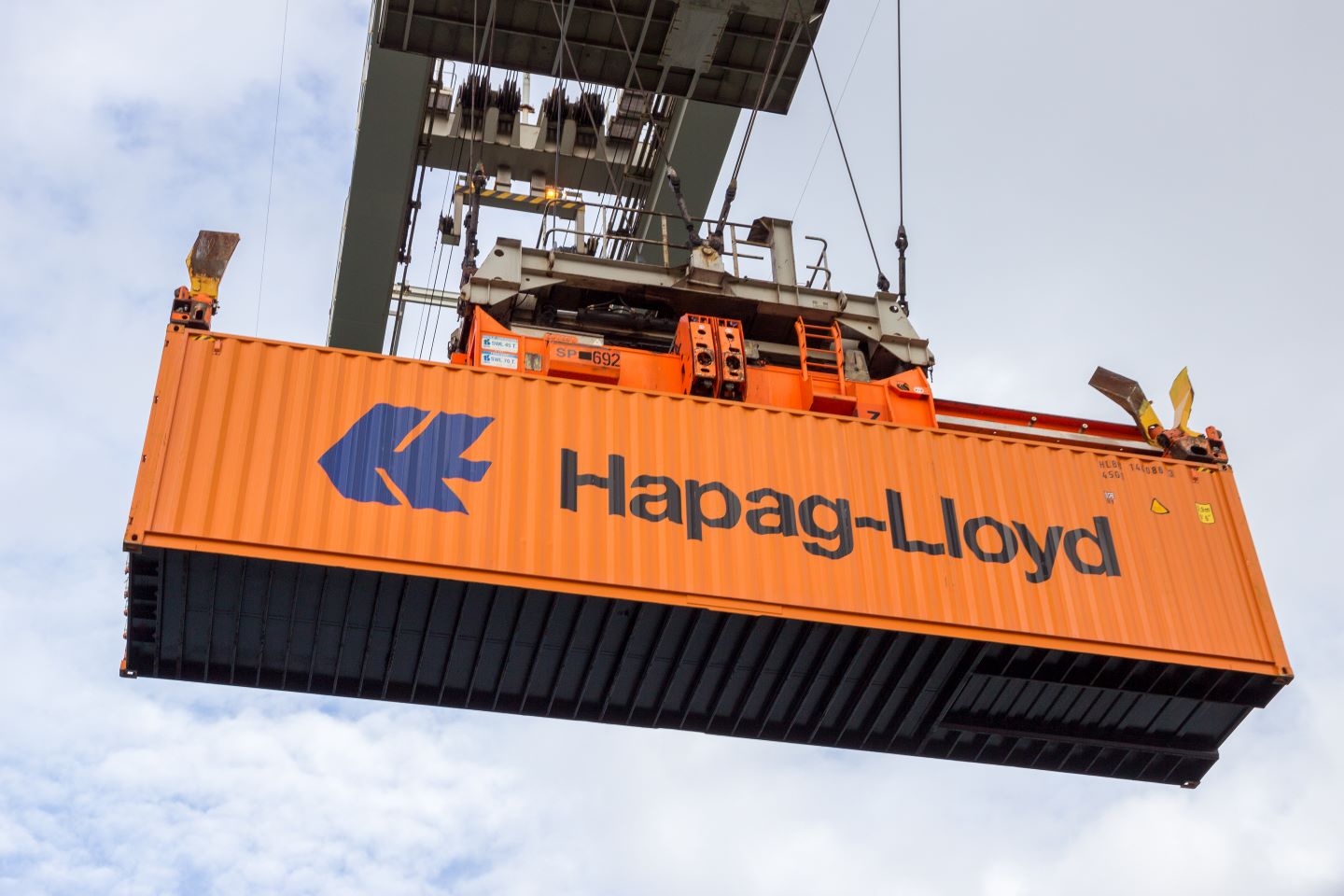
German shipping company Hapag-Lloyd has reached an agreement with global logistics provider DB Schenker with the aim of decarbonising supply chains.
The agreement is based on emission-reduced container transports, using waste and residue-based biofuel.
Go deeper with GlobalData


Discover B2B Marketing That Performs
Combine business intelligence and editorial excellence to reach engaged professionals across 36 leading media platforms.
Hapag-Lloyd offers emission-reduced shipping options, and this agreement will allow customers to continue their freight journey on land with similar environmentally friendlier options.
DB Schenker intends to claim roughly 3,000 metric tonnes of avoided carbon dioxide equivalent (CO₂e) emissions by the end of 2023. This assumes a minimum of 1,000t of pure biofuel.
Hapag-Lloyd said the agreement forms part of its efforts to cut emissions and decarbonise its fleet to become “net zero” by 2045.
Hapag-Lloyd managing director Henrik Schilling noted the importance of this cross-sector deal.
Schilling said: “We are excited about this new partnership with DB Schenker as we share the common goal of making logistics more sustainable. Collaborations like these set a clear signal in the industry and are another example of a step-by-step approach to further decarbonise supply chains.”
DB Schenker opted for Hapag-Lloyd’s sustainable transport solution following the introduction of ‘Ship Green’ in May 2023.
Hapag-Lloyd stated that all biodiesel used for Ship Green is sourced from certified supply chains and produced from waste and residue-based material.
The materials used include brown grease or used cooking oil, guaranteeing that no edible virgin oils are included in the fuel.
Thorsten Meincke, global board member for air & ocean freight at DB Schenker, acknowledged how this agreement puts them one step forward towards their goals of carbon neutrality.
Meincke said: “I am very pleased that together with Hapag-Lloyd we are setting another example for sustainability in our industry. This partnership further enlarges our global biofuel offer in ocean freight. With this commitment, we are one step closer to our goal of becoming carbon-neutral.”
This arrangement builds on earlier Hapag-Lloyd biofuel production advances, including a multi-year partnership with Shell supplying liquefied natural gas (LNG) to Hapag-Lloyd’s large dual-fuel container vessels.
Furthermore, since 2020, Hapag-Lloyd has been testing advanced biofuels to provide a carbon-reduced transportation alternative utilising biofuel blends rather than typical fossil marine fuel oil (MFO).


