

Japanese feeder shipping line Imoto Lines and maritime software company Marindows are developing a hybrid zero-emission container ship using Japan’s first exchangeable container batteries.
The three-year project is aiming to create a vessel with zero emissions over its entire lifecycle by using a range of technologies such as container batteries and other power solutions, including onboard batteries and generators.

Discover B2B Marketing That Performs
Combine business intelligence and editorial excellence to reach engaged professionals across 36 leading media platforms.
Backed by the Japanese Ministry of Environment’s FY2024 Carbon Neutral Technology Research and Development Programme, the 200 TEU vessel will be built by Miura Shipbuilding and is planned for demonstration on the 180-mile (333km) Kobe to Hiroshima service for Imoto.
A company overview of the project explained: “For shipping companies operating globally, reducing CO2 emissions in the supply chain (Scope 3 and 2) is directly linked to international competitiveness, but the use of renewable energy in ships is just beginning to be developed.
“This ship will achieve complete zero-emission from fuel mining and manufacturing to usage, by being propelled by renewable energy charged in container batteries.”
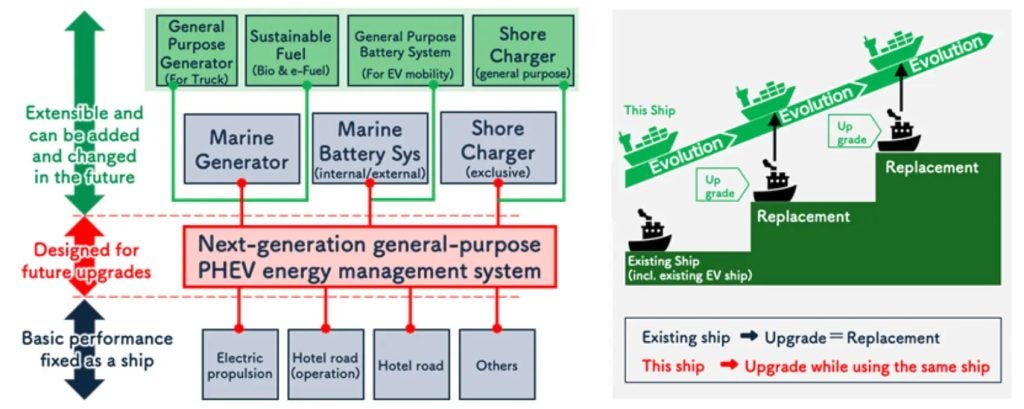
In addition to developing new technology that will make it easier and quicker to take on new power while docked by switching out depleted container batteries for charged replacements, the project is hoping to address the industry-wide crew shortage issue.
According to plans, the vessel will require fewer crew and less experience of electrification through the standardisation and modularisation of the technology, which will also make land support for the tech easier.
The vessel, set to finish construction in January 2027, is not the only ship currently in development using exchangeable battery container technology, with companies such as Wartsila working on similar solutions, but is emblematic of the international efforts to create zero-emission technology for the maritime industry.
Imoto and Marindows’ focus on addressing scope 2 and 3 emissions is also key to the project’s success, with the two companies planning on using renewable energy at Kobe and Hiroshima ports to charge the container batteries.
The project is also claiming to be more cost effective than other next generation vessels, with Marindows saying that the flexible design and focus on standardisation will help to reduce overall costs.


