
The economic cost of fighting and evading pirates reached $7bn last year, 2011, according to US-based Oceans Beyond Piracy.
Go deeper with GlobalData


Discover B2B Marketing That Performs
Combine business intelligence and editorial excellence to reach engaged professionals across 36 leading media platforms.
The report revealed that about 80% of all costs are borne by the shipping industry, while governments picked up the remaining 20% of the cost of counter piracy attacks.
The cost included $2.7bn in fuel costs because vessels have to increase speed while passing through piracy infested areas, $1.3bn for military operations and $1.1bn for security equipment and armed guards on vessels. The latest estimate says, the cost has dropped from the $2bn spent in 2010 to combat the piracy menace.
Oceans Beyond Piracy programme manager and the co-author of the report Anna Bowden said the report assesses nine different direct cost factors specifically focused on the economic impact of Somali piracy.
“The human cost of piracy cannot be defined in economic terms and we do note with great concern that there were a significant number of piracy-related deaths, hostages taken and seafarers subject to traumatic armed attacks in 2011,” Bowden said.
“This happened in spite of the success of armed guards and military action in the later part of the year.”
Additionally $635m was spent on insurance, $486m to $680m on re-routing vessels along the western coast of India and $195m for increased labour costs and ‘danger pay’ for seafarers. Average piracy ransoms increased 25% from approximately $4m in 2010 to $5m in 2011.
The total ransom paid in 2011 was estimated to be $160m though the money collected by pirates accounted to a mere 2% of the total economic cost. The economic cost was sharply in contrast to $38m spent for prosecution, imprisonment and building regional and Somali capacity to fight piracy. The report said pirates expanded their reach eastwards towards India and northeast towards the Gulf of Oman and Strait of Hormuz.
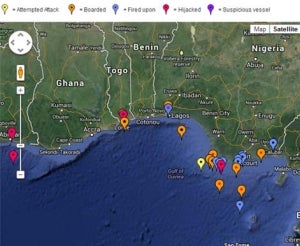
An International Maritime Bureau report had revealed the number that reported attacks at 439 last year out of which 275 were reported off the Somalian coast and in the Gulf of Guinea on the west coast of Africa. The IMB said 802 crew members were taken hostage in 2011, reporting a decrease from the four-year high of 1,181 in 2010.
According to the report, last year there were 45 vessels hijacked, 176 vessels boarded, 113 vessels fired upon and 105 reported attempted attacks, while eight crew members were killed in that period, the same number as 2010.
Image: According to the report, about 80% of all costs are borne by the shipping industry, while governments picked up the remaining 20% of the cost of counter-piracy attacks. Photo: IMO.



