

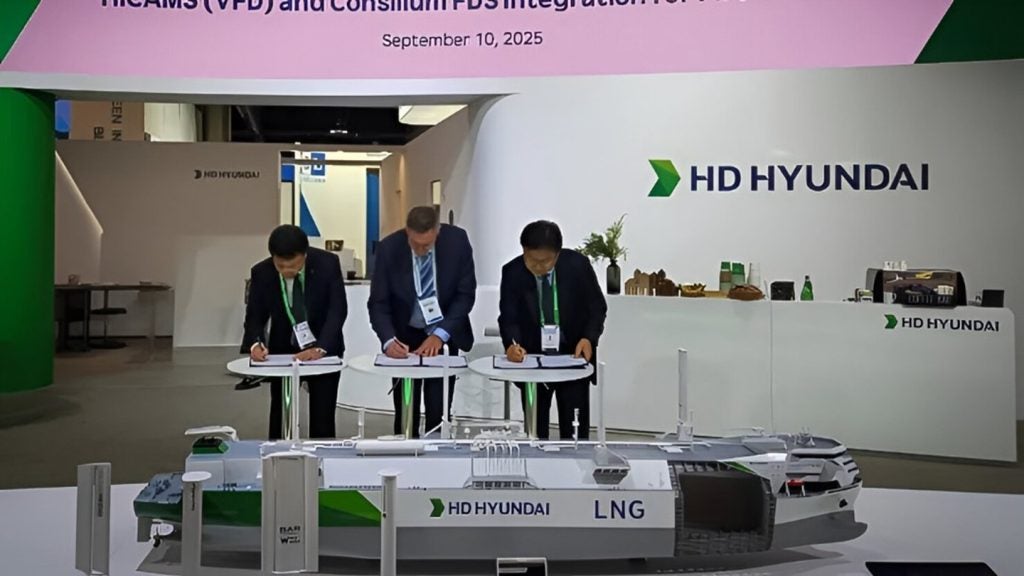
Consilium Safety Group and Hyundai Heavy Industries have entered into an agreement to assess the use of AI-powered cameras for fire detection in maritime environments.
The companies signed a memorandum of understanding (MoU) at the Gastech exhibition in Milan, outlining plans to test Hyundai Heavy Industries’ HiCAMS technology as part of certified fire alarm systems aboard ships.
Currently, a pilot programme is in progress on the test vessel Sawasdee Sunrise in South Korea.
In this trial, HiCAMS has been connected with Consilium’s Safety Management Interface Graphics (SMiG) to initially focus on detecting smoke and flames.
This represents an early example of camera-based fire detection being considered for direct application within the shipping industry, whereas similar technology has already appeared in other sectors, according to Consilium.
The initial phase of this collaboration targets container vessels.
Consilium’s existing Temperature Monitoring System (TMS) is used to track temperature increases in containers stored below deck, while HiCAMS will be deployed to monitor for smoke above deck among cargo containers.
Consilium chief technology officer Thobias Ernfridsson said: “There is strong interest in combining proven systems like TMS with new detection methods for areas where additional coverage is needed.
“Working with Hyundai on HiCAMS, a proven video-based fire detection technology, we aim to demonstrate its potential as a key component of certified fire alarm systems for maritime safety.”
Ernfridsson has also noted that the potential applications for this technology extend beyond the container ship segment.
As the next phase, the partnership intends to begin discussions with a classification society to seek Approval in Principle (AIP).
Achieving this would verify that the technology is suitable for integration into certified fire alarm systems and allow for a full proof-of-concept assessment, said Consilium.
In September this year, HD Hyundai Heavy Industries and Korean Register (KR) signed a memorandum of understanding (MoU) to collaborate on the development of a very large ethane carrier (VLEC).