

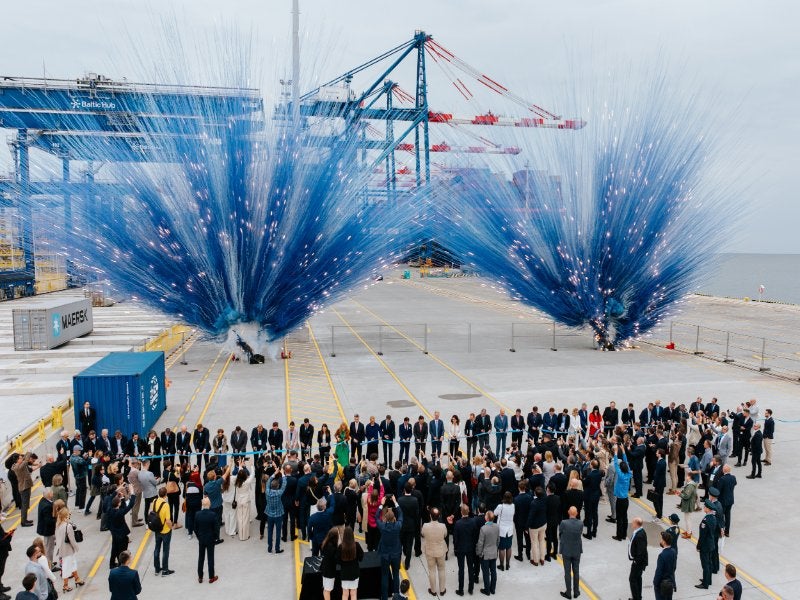
Baltic Hub’s T3 development is a new expansion built to increase the capacity of the container terminal in Gdansk, Poland.
The notice to proceed with construction of the €470m ($548m) project was issued in September 2022, after obtaining all required permits and approvals. Construction officially began in November 2022 and was carried out in two stages.
Recommended Buyers Guides

The first stage involved reclaiming more than 36 hectares (ha) of land using approximately 4.3 million cubic metres (mcm) of sand, followed by the construction of the quay wall in the second stage.
Baltic Hub officially inaugurated the T3 terminal in June 2025, and it became operational in November 2025.
The project increases Baltic Hub’s total handling capacity by nearly 1.5 million TEUs a year to 4.5 million TEUs.
The expansion also enables the terminal to accommodate the largest container vessels, positioning Baltic Hub as a critical logistics centre for Central and Eastern Europe.
Baltic Hub counter terminal location
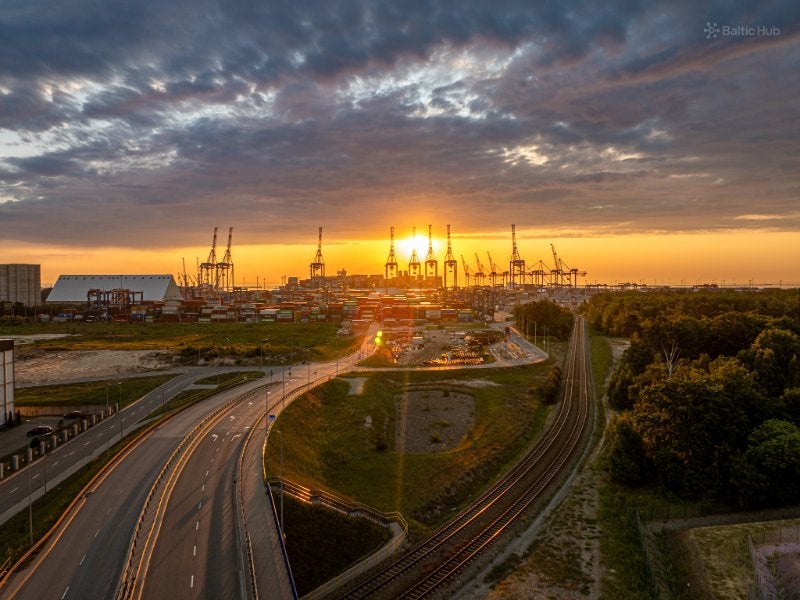
DCT Gdansk, which was rebranded as Baltic Hub in October 2022, is situated within the Port of Gdansk in the City of Gdansk, which serves as the capital of the Pomeranian Voivodeship in northern Poland.
The facility is the only deepwater container terminal in the Baltic and serves as the main gateway for Polish cargo flows and Baltic transhipment operations.
Baltic Hub is owned by PSA International (40%), the Polish Development Fund (30%) and the IFM Global Infrastructure Fund (30%).
Terminal 1 (T1), in operation since 2007, is designed to handle large container vessels arriving from the Far East, while Terminal 2 became operational in 2016, and it is tailored for ultra-large container vessels (ULCVs).
T3 is within the inland waters of the Port Północny (Northern Port) in Gdansk, created through additional dredging and land reclamation to the south-east of the existing T1 terminal.
Baltic Hub T3 container terminal design details
The T3 terminal spans over an area of 36.4ha and is built entirely in the water. It features a 717m quay with a water depth of 17.5m, enabling it to accommodate large container vessels.
The project included creating an artificial island, dredging of the seabed, construction of the deepwater quay, and building a container yard.
The design involved the use of low-emission building materials and green technologies to ensure minimal environmental impact and protect marine habitat.
Key infrastructure elements of the project include loading and unloading docks, advanced electrical switchboards to supply power to ships, mooring bollards, rescue ladders, fender devices and rainwater drainage systems.
Additionally, the terminal includes storage yards for solid, empty, and refrigerated containers, workshops, administrative buildings and offices.
All terminal equipment runs on green electricity, supporting Baltic Hub’s sustainability targets of cutting carbon emissions by 50% by 2030 and achieving net-zero emissions by 2050.
Details of T3 cranes
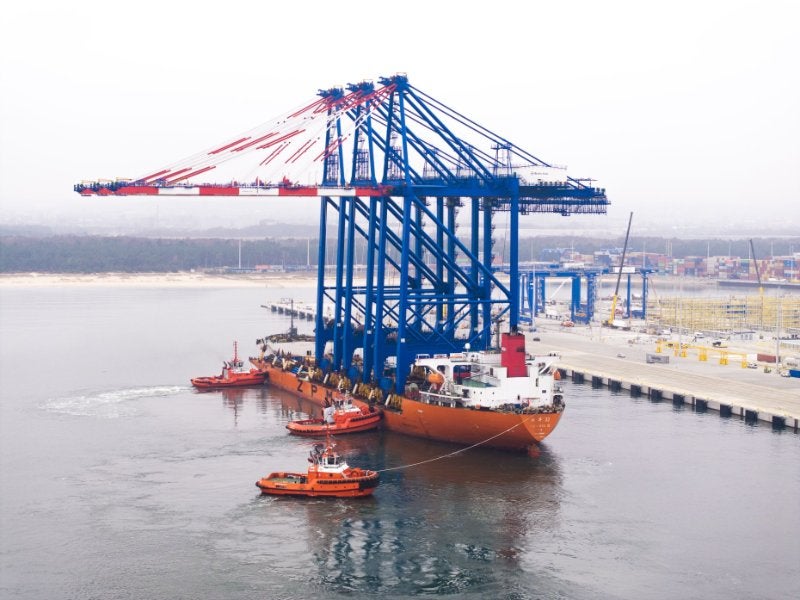
The Baltic Hub T3 terminal features seven semi-automatic ship-to-shore (STS) cranes. These cranes, among Europe’s tallest, are designed to handle vessels of 24,000 TEUs and above.
The STS cranes are 96m high (140m with the boom raised), can extend across vessels to a length of 74m (26 containers wide). These units can pick up a container weighing up to 65t to a height of 55m.
The cranes were fully assembled in China and were transported 29,500km by sea to Poland. The first four arrived in October 2024 and the final three in March 2025.
Baltic Hub’s T3 terminal is also equipped with 20 remotely operated automated rail-mounted gantry cranes (aRMGs) to optimise container handling and improve operational safety.
The fully electric cranes are operated from an off-yard operations centre in the administrative building.
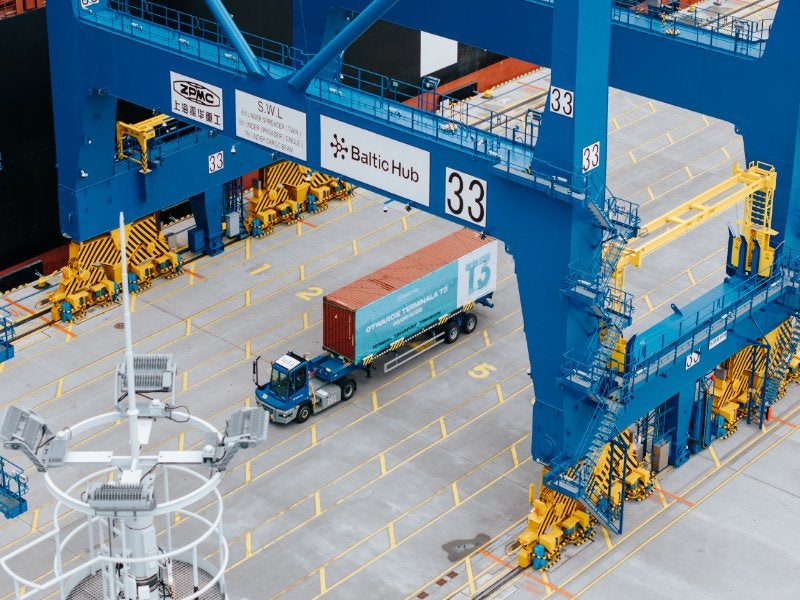
Remote operating stations (ROS) will monitor truck handling while optical character recognition (OCR) technology will be used to identify individual container numbers. Internal/external truck recognition is based on radio frequency identification (RFID) technology that captures smart labels through radio waves.
Financing of T3 terminal project
Baltic Hub financed the project using a combination of its own funds and capital raised from external lenders.
In October 2022, the EBRD provided a €100m loan for the new terminal. The package was part of a €863.5m multi-bank financing package arranged by a consortium of local and international lenders to refinance the company’s existing debt, finance capital expenditure for the construction of Terminal 3 and supply working capital.
Contractors involved
In July 2022, a consortium of DEME Dredging and Polish construction group Budimex won the contract to build the T3 terminal. DEME was responsible for dredging and reclamation works.
Shanghai Zhenhua Heavy Industries (ZPMC) supplied STS cranes for T3 while Austrian crane builder Kuenz, together with the systems integrator ABB, delivered 20 aRMGs cranes.
Netherlands-based engineering consultancy company Haskoning was contracted to manage and supervise site investigations for T3. The scope of work included geotechnical investigations, masterplanning, concept and preliminary design, constructability and cost review, contract strategy development, securing building permits and consents, tender management, and construction supervision services.
Construction and power engineering company Mega carried out energy installation works at the terminal. Mega delivered 130km of cable ducts, laid 80km of medium-voltage and 200km of low-voltage cables, and installed switchgear bays, 23 transformers, reefer sockets and lighting fixtures.
Uponor Infra supplied more than 10km of polyethylene and polypropylene pipes for the drainage system of the container terminal.
Other contractors involved in the project are Richert and Mostostal Krakow.
