

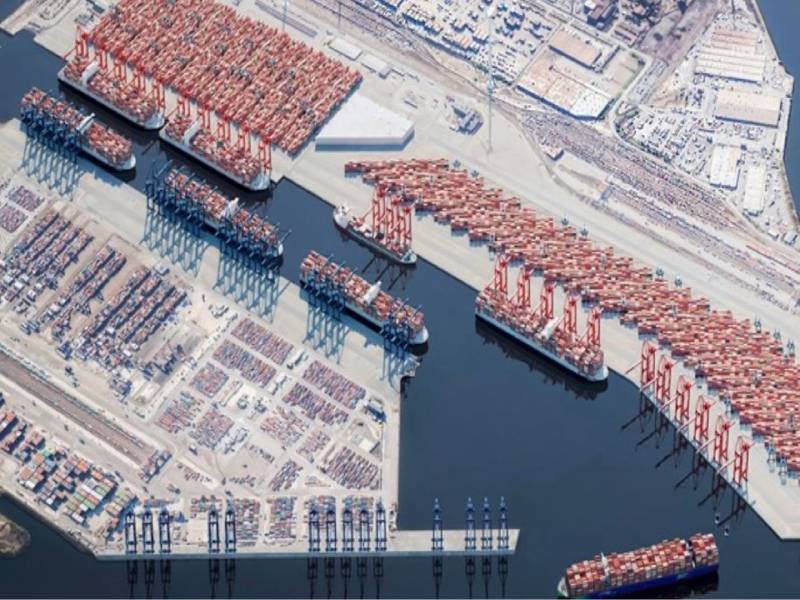
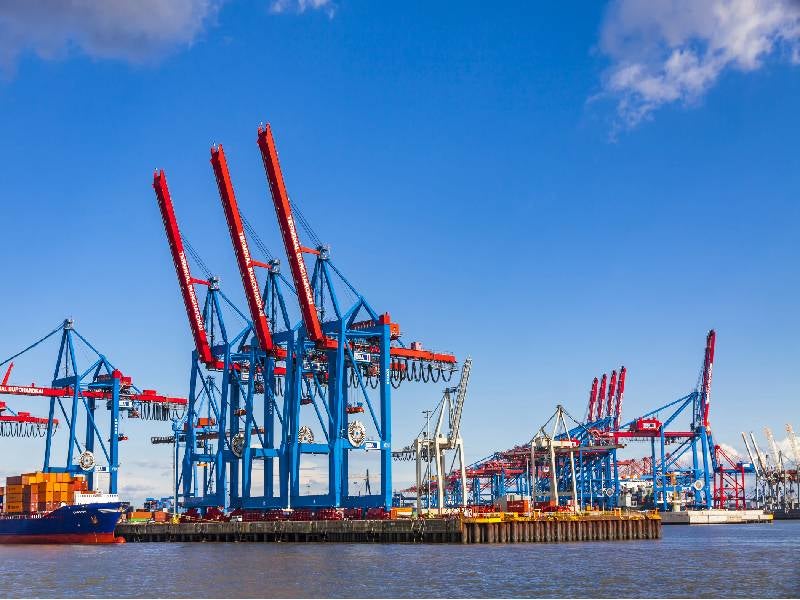
The Waltershofer Hafen modernisation is a large-scale infrastructure project being undertaken at the Port of Hamburg, Germany, to enhance the port’s capacity and efficiency.
The Hamburg Port Authority (HPA) is responsible for overseeing the initiative, which includes expanding the harbour and improving terminal operations, while German independent container terminal operator Eurogate will implement the operational and innovation concepts.
Recommended Buyers Guides

The €1.1bn ($1.3bn) project is part of the 2040 Port Development Plan and aims to create modern berths and operational areas for container ships, reinforcing Hamburg’s status as a key hub on major international shipping routes.
The new areas that extend from the existing Container Terminal Hamburg (CTH) will be fully integrated into the road and rail networks.
Construction of the project commenced in 2024. The public infrastructure improvements are planned to be completed by the mid-2030s, with the newly developed areas scheduled to be handed over to Eurogate by 2036.
Location
The Port of Hamburg is strategically located between the North Sea and the Baltic Sea, making it a crucial hub for international trade in Germany.
This geographical positioning allows the port to serve as the largest multipurpose port in the country, providing access to European inland markets that encompass approximately 450 million consumers.
The port benefits from its proximity to the Kiel Canal, the busiest navigable artificial waterway globally, which enhances connections to the Scandinavian region and the Baltic States.
Additionally, the Elbe River and the Elbe-Seiten Canal facilitate efficient transport of goods by river barge to central and southern Germany, extending as far as the Czech Republic.
Waltershofer Hafen modernisation details
The modernisation of the Waltershofer Hafen will focus on integrating advanced technologies and sustainable practices. It will include the enhancement of the Elbe approach with additional terminal yards, adding a land area of 38 hectares to the existing port.
The expansion will make navigation towards the Container Terminal Buchardkai (CTB) and CTH easier and faster. CTB and CTH are the two major terminals at the port, where 90% of large container ships are handled.
The project will increase the port’s capacity to handle container cargo, with a focus on accommodating large vessels with capacities exceeding 23,000 twenty-foot equivalent units. The new operational areas will enhance the efficiency of cargo handling and storage.
Construction details
Construction will involve excavation and land reclamation efforts, including widening the turning basin from 480m to 600m.
The turning circle will be expanded to the south and southwest, enabling ships to maintain a greater distance from the north bank during turning manoeuvres.
The new quay wall, extending more than 1km, will accommodate two additional berths for modern container ships. This expansion will streamline operations within the basin and increase handling capacity.
Soil will be excavated from the eastern headland situated north of the Petroleumhafen and along the Bubendey bank to support port operations.
Excavated soil will be stored in the petroleum harbour and used as backfill material in an area separate from the waterway. The existing port basin will be infilled after it is sealed off from the river by a dam.
Financing
Eurogate has committed at least €700m ($824m) for the expansion of the existing container terminal.
Port of Hamburg 2040 Port Development Plan
The 2040 Port Development Plan envisions Hamburg as a port of innovation, founded on quality, sustainability and value creation.
The roll-out of digital and autonomous systems will make the port more efficient and climate‑friendly, bolstering its competitiveness against other European hubs and unlocking new avenues for value creation.
The plan focuses on decarbonisation, renewable energy, circular business models and the preservation of critical natural resources that will deliver environmental sustainability alongside economic resilience for the port.
Port infrastructure will be developed responsively, in line with demand, to enable efficient, competitive and sustainable operations. This approach will help safeguard existing jobs, create new employment opportunities and maintain good working conditions.
