
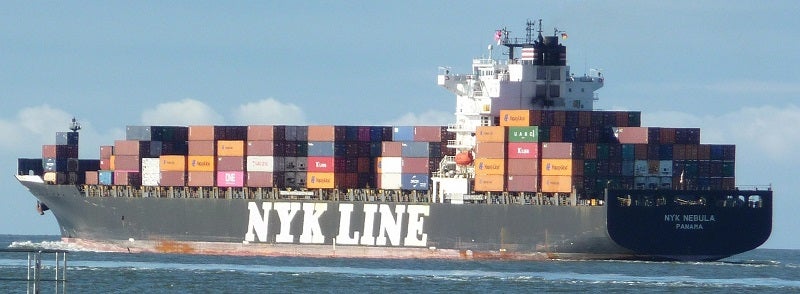
Swiss engine designer Winterthur Gas and Diesel (WinGD) has secured a contract to deploy hybrid energy systems on four newbuild pure car and truck carriers (PCTC).
These vessels will be constructed for Japanese owner NYK Line and are expected to be delivered in 2023.
Go deeper with GlobalData


Discover B2B Marketing That Performs
Combine business intelligence and editorial excellence to reach engaged professionals across 36 leading media platforms.
China Merchants JinLing Shipyard, Nanjing, will be responsible for the construction of the vessels.
The ships will operate on liquefied natural gas (LNG), with WinGD’s 7X62DF-2.1 two-stroke engines, along with DC-links, battery systems and shaft generators.
The newbuilds are anticipated to carry vehicles mostly between Europe and the Middle East.
Through WinGD’s new Hybrid Control System, the company will support system integration as well as system-level energy management.
The company stated that it has improved spinning reserves, peak shaving and energy flow for enabling the main engine to operate constantly while evading inefficient generator loads.
Additionally, the LNG-battery configuration is expected to reduce carbon equivalent emissions by around 40% compared to ships running on heavy fuel oil.
NYK Line ship design team deputy manager Mr Keita Fukunaga said: “Battery hybrid technology improves fuel efficiency and emissions by mitigating main engine and electrical generator load fluctuations.
“This project is an important step in our plan to replace current vessels to newly built LNG-fuelled PCTCs, reducing the fleet’s carbon intensity by 50% by 2050.”
Hybrid power systems can function on several operating modes, including peak shaving, for efficient deep-sea shipping.
Other modes are efficient port manoeuvres and bow thruster operation, along with the use of batteries instead of auxiliaries for offering spinning reserve to fulfil the requirement of emergency power.
In a statement, WinGD said: “As low-speed engines are inherently more efficient than four-stroke engines, the carefully managed use of the main engine and electrical energy management aided by batteries can optimise the loading of auxiliary engines.”
In 2019, WinGD released a set of four new short-stroke engines for different types of vessels.



