

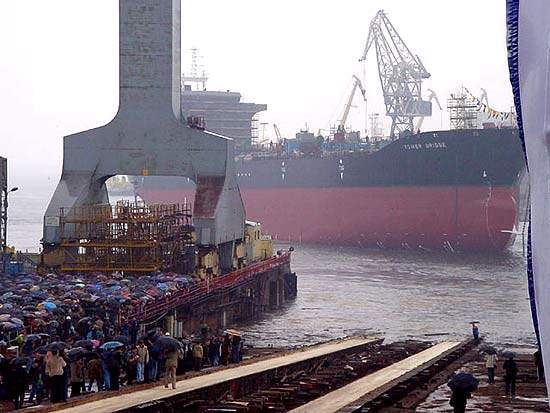
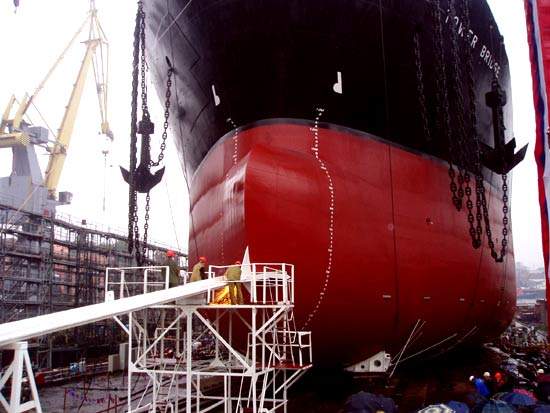
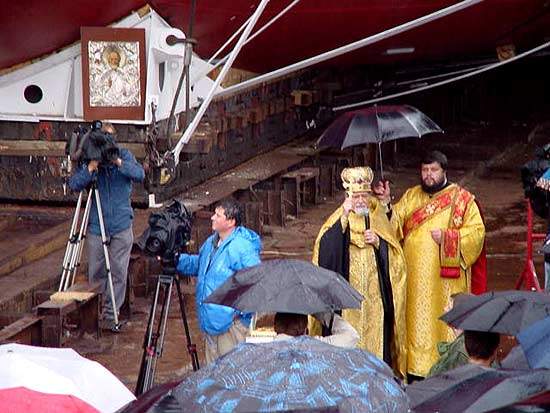
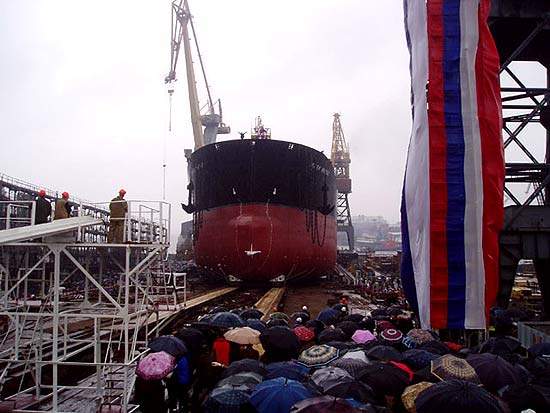
The Tower Bridge is the third of the eight vessels of Troitskiy Bridge series built at the Admiralty Shipyards, Russia, for Sovcomflot. The Troitsky Bridge was delivered in November 2003 and the Tuchkov Bridge followed in April 2004. The keel of the fourth vessel, the Torgovy Bridge, was laid in September 2004 and was delivered in September 2005, while the remaining four tankers were delivered between May 2006 and April 2008.
The vessel was designed to transport simultaneously more than five various types of cargo including crude oil and petroleum products, vegetable oils and IMO Type III chemicals.
Recommended Buyers Guides

The Tower Bridge has an overall length of 182.5m or 174.8m between perpendiculars. Its breadth is 32.2m and the depth to the upper deck measures 17.5m. The draught is 12m and vessel has a deadweight of 47,400t and registers 27,725gt.
The Tower Bridge design, which was carried out by Admiralty Shipyards, specified a double hull in accordance with modern safety and environmental concerns. The width of the skin is 2m at the sides and 2.15m at the bottom.
Cargo, tanks and ballast
The tanker can carry 54,232m² of liquid volume. There are ten cargo tanks arranged in a 5 x 2 tank configuration. There are also two slop tanks.
Moving and exporting these oils are done by means of ten SD 200 cargo pumps as well as two SD 125 pumps, supplied by Frank Mohn. The cargo pumps have an output of 550m³/hr while the two tank pumps have an output of 200m³/hr.
Each tank has its own heating system and there is a hot water tank cleaning system using sea water heated to 60°C.
The Tower Bridge has sophisticated fire monitoring and extinguishing facilities based on an Autronica BS100 detection system and a Unitor extinguishing system. The cargo spaces are deluged by foam whereas the engine room has a CO2 blanket.
The movement of the cargo and ballast around the ship is controlled by a Kongsberg ballast control system. There is 21,196m³ of water ballast in its bunkers as well as 146m³ of diesel oil.
Propulsion, navigation and manoeuvring
The tanker can also store 1,655m³ of fuel oil. At a consumption rate of 29.8t/day of oil for its main engine, it has a cruising range of roughly 12,000 miles.
The main engine system is based on a MAN B&W 6S50MC-C design manufactured by Brynsk. It has an output of 8,130kW at 123rpm. This is linked to a Nickel Bronze Aluminium Kamewa propeller. The fixed pitch unit has a diameter of 5.8m.
The Tower Bridge also has a pair of boilers, both supplied by TPK Nova. The KLN/VIC 1910 is an oil fired boiler with an output of 19t/hr while the KIP/PCK 1000/10 is an exhaust gas boiler with an output of 1.6t/hr.
For power supply, there are three diesel-driven gensets. These consist of two Wartsila 8L20 engines with an output of 1,350kW, each driving a van Kaick DSG99L 1-8 alternator with an output of 1,600kVA, and a Wartsila 4L20 with an output of 720kW driving a van Kaick DSG86L 1-8 alternator with an output of 850kVA.
The accommodation lies in the stern of the ship. The ship is manned by a complement of 12 officers and ten crew, with berths for up to ten suez / repair crews. Above the galleys and messrooms is the bridge.
This contains a Transas Eurasia integrated bridge system as well as a Plath navipilot, two Litton radars and an ARPA S-band and X-band radar.
The Tower Bridge series is classified by Lloyds Register under the notation +100A1, Double Hull Oil Tanker, ESP, SPM, SG 1,025, +LMC, UMS, IGS, LW5, L1, SCM, PCWBT.
